
Article
Incident Reporting Requirements for Virginia Group Homes (DD Waiver)
It's 11:30 p.m. on a Friday. Is it a 24-hour report or a 72-hour report? A practical guide to what Virginia DD waiver group homes are required to report, the timelines that matter, and how to build systems so your staff isn't guessing at midnight.

CareHub by DSPlife
·3 min read
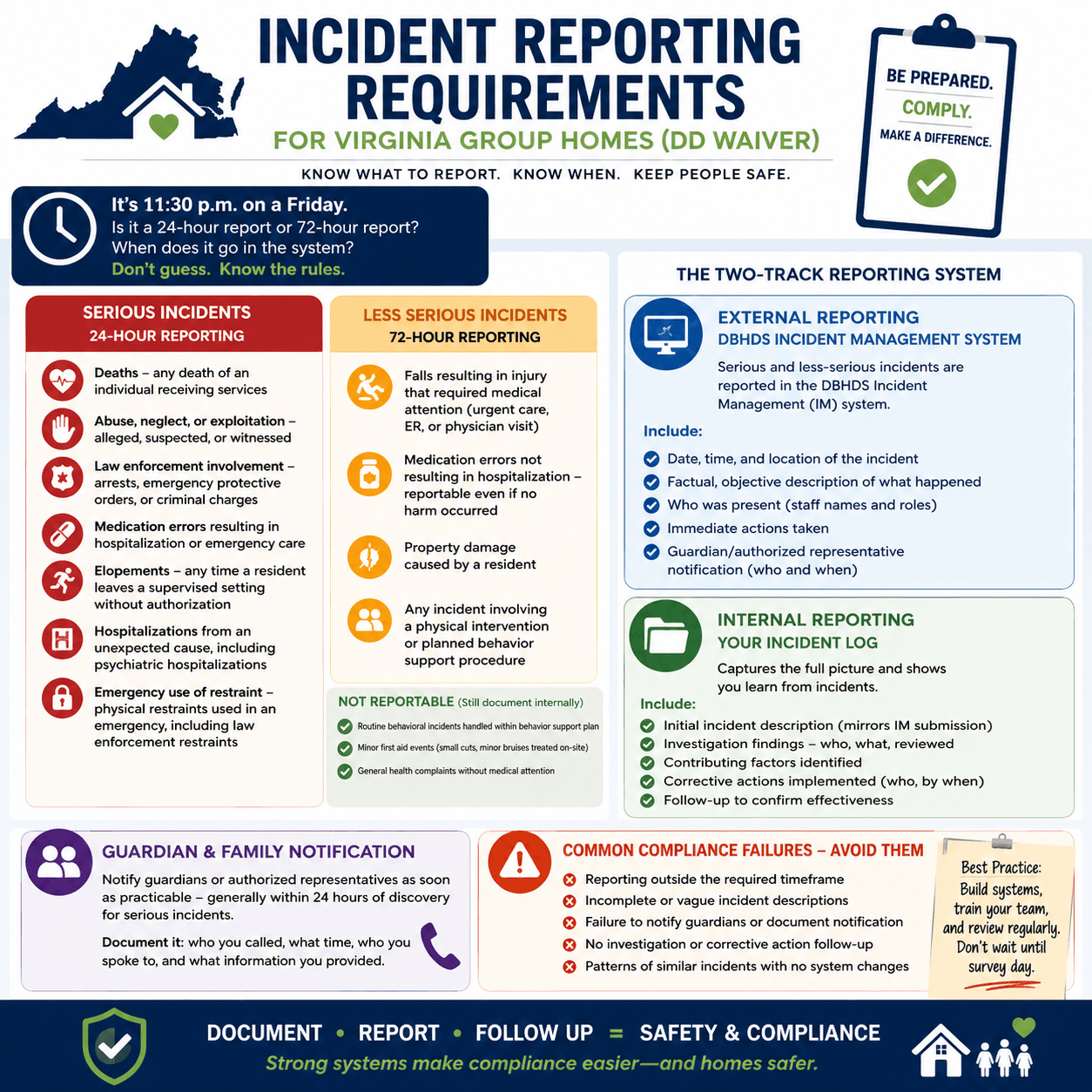
Picture this: It's 11:30 p.m. on a Friday. A staff member calls to report that a resident had a fall and was taken to the urgent care clinic. You're the director on call. You're tired, the paperwork is on a shared drive somewhere, and you're not 100% sure. Is this a 24-hour report or a 72-hour report? Does it go in the electronic system tonight, or can it wait until Monday?
If you've managed a Virginia DD waiver group home for more than a few months, you've been in some version of that moment. Incident reporting is one of the most consequential and most frequently cited compliance areas for providers under DBHDS oversight. Get it right and you demonstrate a culture of safety and transparency. Get it wrong and you're looking at a citation, a corrective action plan, or worse.
This guide breaks down exactly what Virginia group homes are required to report, the timelines that matter, what documentation must look like, and how to build systems so your staff isn't guessing at 11:30 p.m.
What Qualifies as a Reportable Incident in Virginia?
The Virginia Department of Behavioral Health and Developmental Services (DBHDS) defines reportable incidents under the Human Rights Regulations and the DD waiver provider manual. Not every bad day is a reportable incident, but a lot more things qualify than many providers realize.
Serious Incidents (24-Hour Reporting)
The following must be reported to DBHDS within 24 hours of discovery:
- Deaths. Any death of an individual receiving services, regardless of cause.
- Abuse, neglect, or exploitation. Alleged, suspected, or witnessed.
- Law enforcement involvement. Arrests, emergency protective orders, or criminal charges involving a resident.
- Medication errors resulting in hospitalization or emergency care.
- Elopements. Any time a resident leaves a supervised setting without authorization.
- Hospitalizations from an unexpected cause, including psychiatric hospitalizations.
- Emergency use of restraint. Physical restraints used in an emergency, including law enforcement restraints.
If your staff finds any of these situations when they arrive for a shift, the clock starts at the moment of discovery, not the moment the incident occurred. This distinction trips up a lot of providers.
Less Serious Incidents (72-Hour Reporting)
Some incidents require reporting within 72 hours:
- Falls resulting in injury that required medical attention (urgent care, ER, or physician visit).
- Medication errors not resulting in hospitalization. Still reportable even if no harm occurred.
- Property damage caused by a resident.
- Any incident involving a physical intervention or planned behavior support procedure.
What Does NOT Have to Be Reported
Not everything goes into the incident reporting system. Routine behavioral incidents handled within your program's existing behavior support plan, minor first aid events (small cuts, minor bruises treated on-site), and general health complaints that don't require medical attention typically don't rise to reportable status. However, you should always document these internally, because if a pattern emerges and DBHDS asks, you'll want that paper trail.
The Two-Track Reporting System: Internal and External
Virginia providers operate on a two-track system, and conflating the two is a common source of confusion.
External Reporting: DBHDS Incident Management System
Serious and less-serious incidents go into the DBHDS Incident Management (IM) system (previously known as CHRIS). This is the official external reporting mechanism. Reports submitted here are reviewed by DBHDS licensing staff, and patterns across incidents at your organization can trigger follow-up investigations or licensing reviews.
When completing an IM report, you must include:
- Date, time, and location of the incident
- A factual, objective description of what happened (no opinions, no blame language)
- Who was present, including staff names and roles
- Immediate actions taken (e.g., "staff called 911," "nurse was notified," "supervisor was called")
- Whether the individual's guardian or authorized representative was notified and when
Internal Reporting: Your Own Incident Log
Beyond the DBHDS system, providers are expected to maintain internal incident documentation that captures the full picture: the investigation, root cause analysis, and corrective actions taken. This is what surveyors look at when they want to understand whether your organization learns from incidents or just files paperwork.
A strong internal report includes:
- The initial incident description (mirrors your IM submission)
- Investigation findings: who was interviewed, what was reviewed
- Contributing factors identified
- Corrective actions implemented (and by whom, and by when)
- Follow-up to confirm the corrective action was effective
If you're handing surveyors a pile of incident forms with no evidence of follow-through, expect a citation.
Guardian and Family Notification Requirements
One piece that catches providers off-guard: notification of guardians or authorized representatives is its own requirement, separate from DBHDS reporting.
For serious incidents, you're required to notify the guardian or authorized representative as soon as practicable, generally interpreted as within 24 hours of discovery, or sooner when the incident involves an ER visit, hospitalization, or police involvement.
Document the notification: who you called, what time, who you spoke to (or that you left a voicemail and followed up), and what information you provided. If a guardian later tells a surveyor "no one called me," and you have no documentation that you tried, you're in a difficult position.
Common Compliance Failures, and How to Avoid Them
Based on recurring patterns in DBHDS licensing surveys, here are the most frequent incident reporting failures:
1. Reporting outside the timeline. The 24-hour clock starts at discovery. If your on-call manager finds out about an incident at 6 a.m. Saturday, the external report is due by 6 a.m. Sunday, not Monday morning when the office reopens.
2. Vague or opinion-laden descriptions. "Staff handled the situation poorly" is not appropriate in an incident report. Neither is "the individual was being aggressive as usual." Describe only observable facts: what was seen, heard, or physically documented.
3. Incomplete follow-through on corrective actions. DBHDS doesn't just want to see that you wrote down a corrective action. They want to see evidence it happened. If your corrective action is "re-train all staff on elopement protocols," you need documentation of that training: sign-in sheets, training records, dates.
4. Failing to report because staff weren't sure it qualified. When in doubt, report. A false positive (reporting something that didn't technically need to be reported) carries essentially no penalty. A missed reportable incident can result in a violation. Train your staff to escalate anything that might qualify.
5. No system for tracking incident trends. DBHDS expects providers to analyze incident data over time. If you can't tell a surveyor how many incidents involved falls in the last 12 months, or whether your elopement rate is trending up or down, you're missing a core quality improvement expectation.
How CareHub Takes the Guesswork Out of Incident Reporting
We built CareHub because we lived this problem ourselves. When you're running multiple group homes across shifts, the hardest part of incident reporting isn't knowing the rules. It's making sure staff follow them consistently at midnight on a Saturday without calling the director.
CareHub gives DD waiver providers:
- Guided incident intake forms that walk staff through exactly what information is needed, in plain language, at the moment the incident happens.
- Automatic timeline tracking so you never miss a 24-hour or 72-hour deadline. CareHub flags each incident as CHRIS-required or not, and stamps a deadline you can see at a glance.
- Built-in guardian notification logging, so every call attempt and conversation is documented in the same record as the incident itself.
- Internal investigation templates aligned to DBHDS expectations, including corrective action tracking with due dates and completion confirmation.
- Trend reporting dashboards so you can spot patterns before a surveyor does.
You can also use our IDD Compliance Checklist to audit your current incident reporting process, and take the Audit Readiness Quiz to see where your biggest gaps are.
Start your free 14-day trial at carehub.mydsplife.com. No credit card required. Your staff will be more confident, your documentation will be tighter, and you'll stop dreading the midnight calls.
The Bottom Line
Incident reporting in Virginia group homes is non-negotiable, but it doesn't have to be chaotic. Know your timelines (24 hours for serious incidents, 72 hours for less serious), document objectively, notify guardians promptly, follow through on corrective actions, and build systems your staff can actually use at any hour of the day.
The providers who get cited for incident reporting failures are almost never the ones who didn't know the rules. They're the ones who didn't have a reliable system for executing on them.
DSPlife Collaborative supports DD waiver providers with compliance tools, training, and resources built by people who've done the work. Visit carehub.mydsplife.com to learn more.
Share this article
Help another DD-waiver provider find this.
One short, useful email per week
State regulatory bulletins, customer wins from real DD-waiver providers, a free resource in each issue. One-click unsubscribe.
Keep Reading
More from the CareHub blog
Article
The MAR Errors That Fail a DBHDS Medication Audit (and How to Prevent Them)
The Medication Administration Record is the second thing a DBHDS surveyor pulls after daily notes. Here are the MAR mistakes that draw citations — blank boxes, PRN follow-ups, controlled-count gaps, undocumented refusals — and how to close them before your annual review.
Read articleArticle
Choosing an IDD EHR: The Buyer's Checklist
Most IDD EHR demos look the same for the first twenty minutes. Here is the checklist that surfaces the differences that actually matter — pricing model, what's included, compliance depth, migration, and audit-readiness.
Read articleArticle
ISP Part V (Plan for Supports), Section by Section
The Part V / Plan for Supports is the operational heart of the ISP — the part staff actually document against. Here is what belongs in each section, and what a reviewer checks when they read it.
Read article