Article
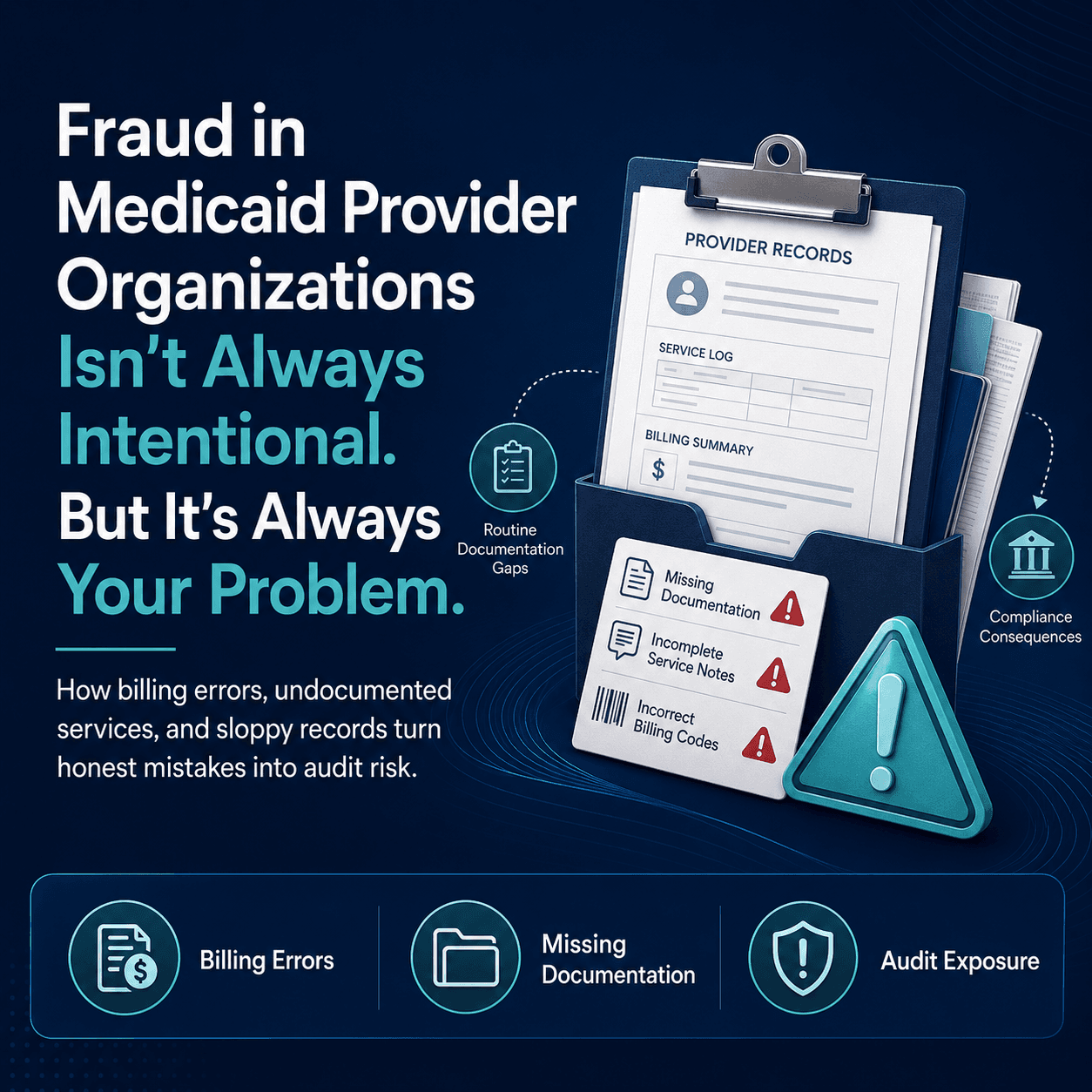
Fraud in Medicaid Provider Organizations Isn't Always Intentional. But It's Always Your Problem.
Most Medicaid documentation risk doesn't start with bad intent. It starts with a gap. Here's how routine workflow problems become audit, repayment, and fraud-review exposure — and what documentation-first operations actually look like.

CareHub by DSPlife
·3 min read
If there is one word Medicaid provider organizations keep hearing lately, it is fraud.
The word sounds extreme. It brings up images of bad actors deliberately gaming the system, falsifying records, and billing for services that never happened.
And yes, that happens.
Virginia has seen Medicaid fraud cases involving false timesheets, blank signed nursing notes, fabricated documentation, services billed but not provided, and billing that exceeded documented staff hours.
But for many provider organizations, the more common risk does not begin with someone trying to steal from Medicaid.
It begins with a gap.
A caregiver completes a visit but forgets to clock in. A supervisor approves a timesheet without comparing it to the schedule. A service note is late. A billing file is submitted before all documentation is complete. A record is corrected after the fact, but there is no clean audit trail showing who changed it, when, or why.
None of those situations may have started with dishonest intent.
But in an audit, investigation, repayment demand, or fraud review, intent is only part of the story. The record matters. The documentation matters. The question is not only whether the service happened.
The question is whether the provider can prove it happened, prove it was documented, and prove the claim was supported before it went out.
Virginia cases show the risk is real
This is not theoretical.
In one Virginia case, six defendants connected to a Medicaid-enrolled home health agency were sentenced after false claims were submitted for services that were never provided. According to the U.S. Attorney's Office, the case involved millions in false Medicaid claims and records used to support services that did not occur. The court ordered restitution totaling $10 million to Virginia Medicaid.
In another Virginia case, a Medicaid provider paid $2 million to resolve civil fraud claims involving adult residential group homes. The government alleged that the provider billed Virginia Medicaid for skilled and other nursing services that exceeded the total number of hours worked by nurses. The settlement resolved allegations, and there was no determination of civil liability.
Virginia has also seen cases involving fraudulent timesheets for personal care and respite services, home health attendants billing for hours not worked, and documentation created or altered after an audit request.
The lesson for provider organizations is clear: documentation problems are not minor back-office issues. They are billing risk. They are audit risk. They are repayment risk. In the wrong fact pattern, they can become fraud risk.
The real question: does the documentation match the claim?
Medicaid provider organizations operate in a heavily scrutinized environment. Federal enforcement agencies, state Medicaid agencies, managed care organizations, licensing bodies, auditors, and program integrity units may all look at the same basic issue:
Does the documentation support the claim?
That question sounds simple until the provider has to answer it across multiple disconnected systems.
The schedule is in one place. The clock-in record is somewhere else. The service note is in another system. The MAR is in a binder. Payroll is exported from a timesheet. Billing is handled separately. Corrections are made through email, text messages, or manual edits.
When the answer becomes, "We think the service happened, but we need to check three places to confirm it," the organization is already exposed.
What fraud risk actually looks like in Medicaid provider operations
Fraud risk does not always announce itself as fraud. In day-to-day operations, it often looks like ordinary workflow problems that were never tightened up.
Visit verification gaps
Electronic Visit Verification creates a record of service delivery, but EVV alone does not protect a provider if the rest of the documentation does not align.
If the EVV record does not match the schedule, timesheet, service note, or billing record, the discrepancy needs to be explained. Maybe the staff person forgot to clock in. Maybe the visit was manually corrected. Maybe the caregiver arrived late. Maybe the service was provided in a different location. Maybe the documentation was completed late.
The issue is not always that a discrepancy exists.
The issue is whether the organization can explain it with records instead of memory.
Undocumented services
A direct support professional provides support. The individual received the service. The family knows the staff person was there. The supervisor may even remember the shift.
But the service note was never completed.
If that service gets billed, the organization now has a claim without complete supporting documentation. That can lead to repayment, audit findings, payer scrutiny, or a larger compliance concern depending on the pattern.
This is where provider organizations get into trouble. Operationally, they focus on whether the care happened. Auditors focus on whether the record proves it happened.
False or inflated timesheets
Timesheet problems are one of the clearest fraud-risk areas because time drives payment in many Medicaid-funded services.
When schedules, clock-ins, timesheets, payroll, and billing are separate, hours can drift. Staff may round time. Supervisors may approve shifts based on memory. Missed clock-outs may be corrected without enough documentation. A timesheet may be approved even though the schedule does not support it.
Sometimes that is deliberate. Sometimes it is an honest mistake.
Either way, the organization owns the risk.
Billing before documentation is complete
Many Medicaid provider organizations run on tight billing cycles. Cash flow matters. Payroll has to be met. Claims need to go out.
But billing pressure cannot move faster than documentation.
If claims are submitted before service notes are completed, signed, reviewed, or tied to the correct service date, the organization is exposed. The service may have happened, but the record does not fully support the billing.
That is the danger zone: care delivered, claim submitted, documentation incomplete.
After-the-fact corrections without a clear audit trail
Corrections happen. That is normal.
The problem is not that a record was corrected. The problem is when the correction cannot be explained.
Who changed it? When? What changed? Why was it changed? Was it a late note, a clarification, a correction to a time entry, or an attempt to make the file match the claim after the fact?
If the system cannot answer those questions, the provider is left trying to explain the record without the record itself doing the work.
What protection actually looks like
The provider organizations with the lowest documentation risk usually have one thing in common:
Their operations and their documentation are tightly connected.
Scheduling, clock-ins, service notes, medication records, approvals, payroll, and billing should not feel like separate worlds. The more disconnected those workflows are, the more room there is for missing records, mismatched time, unsupported claims, and explanations that only exist verbally.
Fraud prevention is not only about catching bad actors.
It is about building systems tight enough that honest mistakes do not become compliance violations.
Specific protections that matter
Schedule-to-clock-in reconciliation
The scheduled shift and actual clock-in should be reviewed together.
If someone was scheduled from 8:00 AM to 4:00 PM but clocked in at 8:47 AM, that should surface immediately. If someone worked an unscheduled shift, that should be visible. If a visit was missed, late, moved, or manually corrected, the system should preserve the story.
The worst time to discover those gaps is six months later during an audit.
Service note completion before billing
A service should not move forward to billing before the documentation is complete.
That does not mean providers need paperwork for the sake of paperwork. It means the system should help prevent unsupported claims.
If the note is missing, incomplete, unsigned, late, or disconnected from the service date, that should be visible before billing happens.
Role-based access controls
Not everyone should be able to edit service documentation after the fact.
DSPs need access to complete their notes. Supervisors need access to review and approve. Administrators may need access to correct records, manage documentation, and oversee compliance.
But those permissions should not all look the same.
When records can be changed without clear limits, timestamps, or audit trails, the organization loses control of its own documentation story.
Audit trails for corrections
Late notes, corrections, and edits should be traceable.
A strong system should show who made the change, when the change was made, and what changed. That matters because unexplained edits, overwritten records, and backfilled documentation can create serious audit concerns.
The cleaner the audit trail, the easier it is to show that the organization is managing documentation responsibly.
Medication administration records
MAR documentation is not just a clinical record. It is part of the provider's compliance record.
Administered doses, refusals, missed medications, late administrations, and follow-up actions all help demonstrate that care was delivered and monitored. Weak MAR documentation creates health and safety risk, but it can also weaken the provider's overall documentation position.
Supervisor review before payroll and billing
Supervisory approval should mean more than clicking "approve."
Before time moves to payroll or claims move to billing, supervisors should be able to review the schedule, clock-in data, service notes, and any discrepancies in one connected workflow.
That review protects the organization because it shows that someone checked the record before money moved.
Fraud prevention is really documentation discipline
Fraud prevention in Medicaid provider organizations is not only about stopping intentional fraud.
It is about closing the gap between what happened and what was recorded.
If the schedule says one thing, the clock-in says another, the timesheet says something else, and the service note is missing, the organization is vulnerable.
Even when the care was provided.
Even when the staff meant well.
Even when the mistake could have been fixed earlier.
The question is whether your records can prove the service was delivered, documented, reviewed, and billed appropriately.
That is what protects the organization.
CareHub was built for documentation-first operations
CareHub was designed around the reality of Medicaid-funded service delivery.
Scheduling, visit records, service notes, medication records, payroll exports, approvals, and documentation workflows are connected by design. That means the documentation layer stays close to the operational layer.
The gaps get smaller.
The records get clearer.
And when the organization needs to answer the question, "Does the documentation support the claim?" the answer is easier to find.
Share this article
Help another DD-waiver provider find this.
One short, useful email per week
State regulatory bulletins, customer wins from real DD-waiver providers, a free resource in each issue. One-click unsubscribe.
Keep Reading
More from the CareHub blog
Article
The MAR Errors That Fail a DBHDS Medication Audit (and How to Prevent Them)
The Medication Administration Record is the second thing a DBHDS surveyor pulls after daily notes. Here are the MAR mistakes that draw citations — blank boxes, PRN follow-ups, controlled-count gaps, undocumented refusals — and how to close them before your annual review.
Read articleArticle
Choosing an IDD EHR: The Buyer's Checklist
Most IDD EHR demos look the same for the first twenty minutes. Here is the checklist that surfaces the differences that actually matter — pricing model, what's included, compliance depth, migration, and audit-readiness.
Read articleArticle
ISP Part V (Plan for Supports), Section by Section
The Part V / Plan for Supports is the operational heart of the ISP — the part staff actually document against. Here is what belongs in each section, and what a reviewer checks when they read it.
Read article