
Article
Staff Credentialing for DD Providers: The System That Prevents Citations
An expired CPR card on a single DSP can blow up an otherwise clean licensing review. Here's the credentialing system that catches expirations before surveyors do.

CareHub by DSPlife
·3 min read
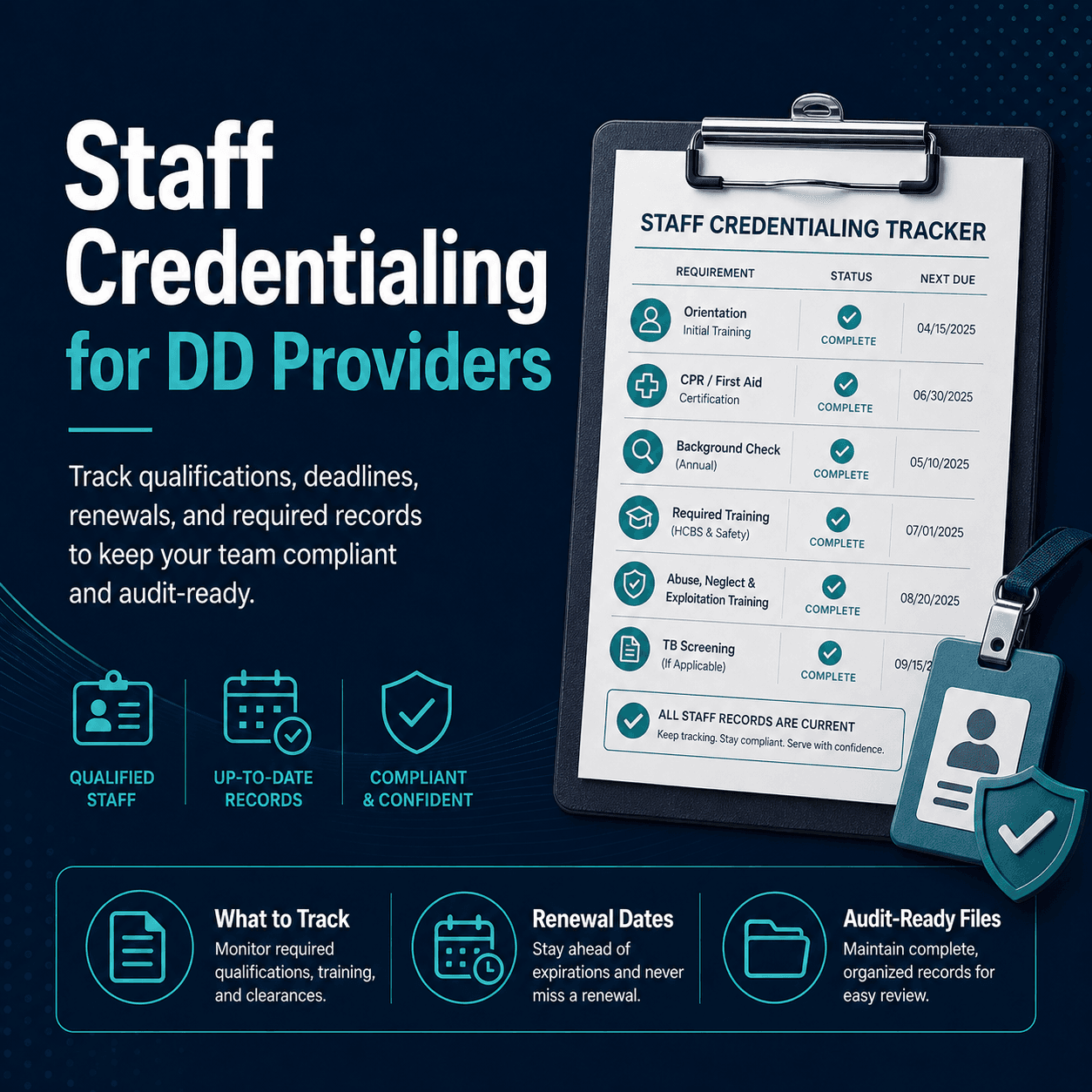
In our review of recent DD licensing reports, the single most common citation across every state isn't documentation, isn't medication management, isn't person-centered planning — it's expired staff credentials. CPR cards, first-aid certs, abuse-and-neglect-prevention training, BCI/FBI background checks. One expired record on one staff person, and you have a citation regardless of how clean everything else looks.
Here is the credentialing system that prevents it.
The credentials every DSP needs
The exact list varies by state and service type, but the universal core:
- BCI / state criminal background check (initial + renewal cycle)
- FBI fingerprint background check
- Child Protective Services check
- Adult Protective Services check
- DMV check (if driving individuals)
- TB test (initial + per state schedule)
- CPR certification (current within 1 or 2 years)
- First aid certification
- Abuse and neglect prevention training
- Rights of individuals served
- Medication administration training (if administering meds)
- Behavior support training (if working with individuals on BSPs)
- Specific health-condition trainings (seizure response, diabetes management, etc.)
- State-specific orientation (DBHDS in VA, DODD in OH, HHSC in TX, etc.)
The expiration math nobody does
Most providers track credentials in a spreadsheet that someone updates "when they have time." The result: at any given moment, 5-10% of credentials are within 30 days of expiration with no renewal scheduled.
Do this math instead:
- Total active staff × average number of trackable credentials per staff = total credentials in motion
- Total credentials in motion ÷ 365 = average expirations per day
For a 30-staff provider with 12 trackable credentials each, that's ~1 expiration per day on average. A spreadsheet updated weekly will always be 7 expirations behind.
A system that actually works
- Single source of truth. One system, every credential, every staff person. Not three folders, not the program manager's email, not the binder in the QA office.
- Automatic expiration alerts. 90 days out, 30 days out, 7 days out, and on the day of expiration. Each alert goes to the staff person and their supervisor.
- Renewal scheduling at hire. When a new DSP is onboarded, schedule the renewal for every credential at the moment of hire. Don't wait for the alert.
- Block scheduling on expiration. A DSP whose CPR cert expires Friday should not be on a residential shift on Saturday. The system that blocks the shift is the system that prevents the citation.
- Quarterly audit of the system itself. Pull a random sample of 5 staff per quarter and verify every credential in the system is also documented in the staff personnel file. If they don't match, the system isn't working.
What surveyors actually pull
A surveyor will:
- Pick 3-5 random staff from the active roster
- Ask for the full credentialing file for each
- Compare what's in the file against what your system says is current
- Flag any discrepancy
The most painful citations come from staff who had the credential but the file is missing the certificate. Have the certificate stored, scanned, and attached to the staff record. A current credential with no proof is the same as no credential.
Where TrainingHub fits
Credentialing and staff training live in TrainingHub, our companion product built for exactly this. TrainingHub assigns the courses your state requires, tracks each staff person's certifications, and flags expirations before a credential lapses — the single source of truth for staff competency. CareHub, meanwhile, keeps your service documentation, MARs, and incident reports audit-ready, so the two together cover both sides of a survey.
TrainingHub is a separate subscription with its own 14-day free trial. See how CareHub and TrainingHub work together.
Share this article
Help another DD-waiver provider find this.
One short, useful email per week
State regulatory bulletins, customer wins from real DD-waiver providers, a free resource in each issue. One-click unsubscribe.
Keep Reading
More from the CareHub blog
Article
The MAR Errors That Fail a DBHDS Medication Audit (and How to Prevent Them)
The Medication Administration Record is the second thing a DBHDS surveyor pulls after daily notes. Here are the MAR mistakes that draw citations — blank boxes, PRN follow-ups, controlled-count gaps, undocumented refusals — and how to close them before your annual review.
Read articleArticle
Choosing an IDD EHR: The Buyer's Checklist
Most IDD EHR demos look the same for the first twenty minutes. Here is the checklist that surfaces the differences that actually matter — pricing model, what's included, compliance depth, migration, and audit-readiness.
Read articleArticle
ISP Part V (Plan for Supports), Section by Section
The Part V / Plan for Supports is the operational heart of the ISP — the part staff actually document against. Here is what belongs in each section, and what a reviewer checks when they read it.
Read article