Article
Person-Centered Plans That Hold Up Under Audit
A PCP that reads beautifully but fails an audit isn't doing the individual any favors. Here's how to write PCPs that are both person-centered and defensible.

CareHub by DSPlife
·3 min read
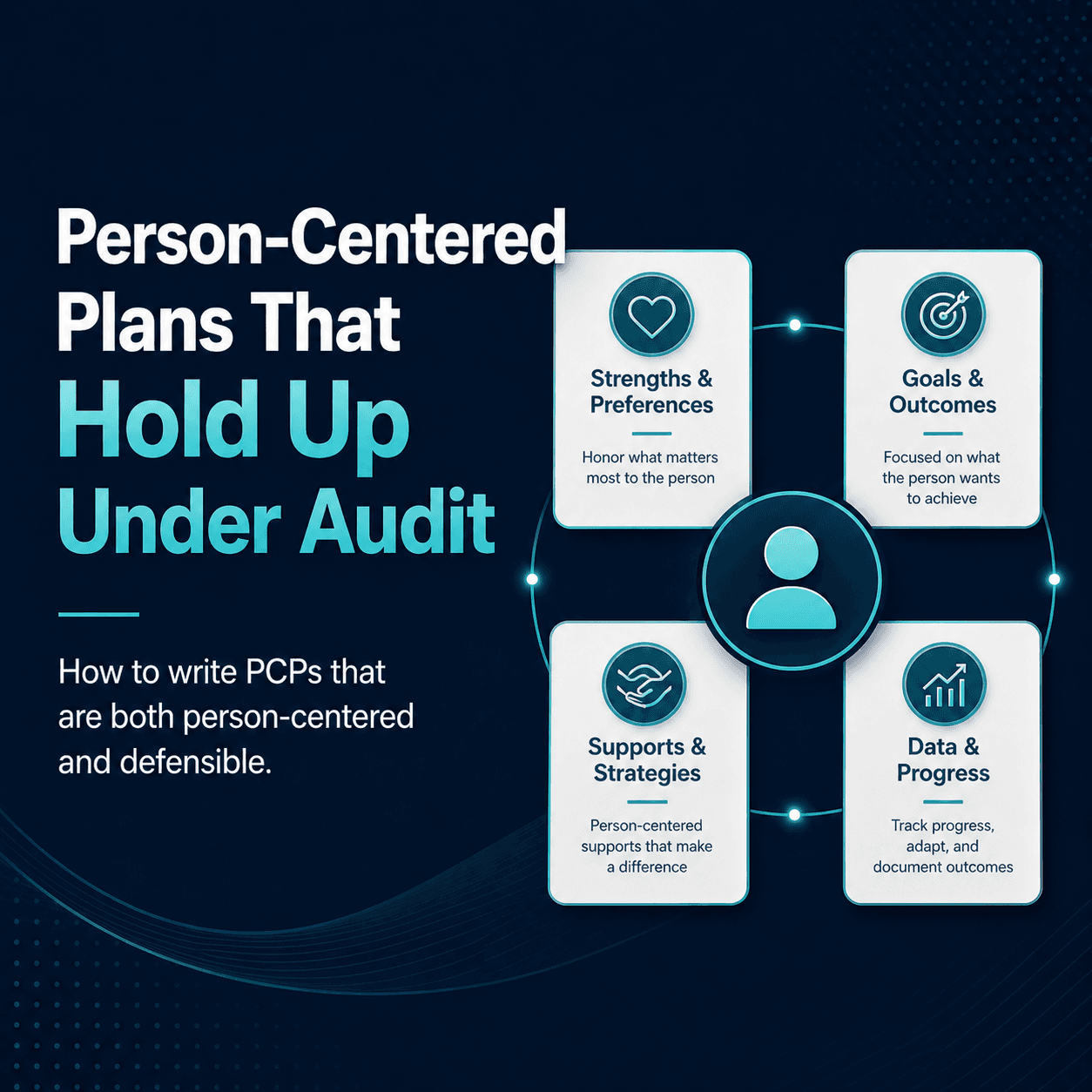
There's a tension in DD documentation that no provider talks about openly: the most beautifully written, person-centered plans often don't survive audit, and the most audit-defensible plans often read like a compliance checklist. The best plans do both.
Here is what that looks like.
The four tests every PCP must pass
- Is it person-centered? Does it sound like the individual? Does it reflect their preferences, choices, and aspirations? Could you read it back to them and have them recognize themselves?
- Are the outcomes measurable? Can a surveyor (or you, six months from now) tell whether the outcome was achieved?
- Are the supports specific? Does each authorized service connect to a stated outcome?
- Is there a back-up plan? What happens when staff don't show up, when the day program closes, when the family member traveling for a week?
A plan that passes all four tests is rare. Most plans pass test 1 or test 2 — not both.
Person-centered without losing measurability
The trap is that "measurable" gets translated as "narrow" and the plan turns into a behavior plan masquerading as a PCP. The fix is to write outcomes in two layers:
The vision (person-centered): "Marcus wants to feel useful. He talks about getting a job, but what he means is that he wants to be needed."
The measurable outcome (audit-defensible): "Marcus will participate in two paid or volunteer activities of his choosing per month, with progress reviewed quarterly. By the end of plan year, Marcus will identify which type of work he wants to pursue more of."
The vision tells you why. The outcome tells you what to measure. Both belong in the plan.
The most-cited PCP findings
- Outcomes that aren't measurable. "Will be more independent" is a wish, not an outcome.
- Authorized services that don't connect to outcomes. A 40-hour-a-week residential service is in the plan but no outcome describes what those 40 hours support.
- No back-up plan. Required in most state waivers; surveyors will ask.
- Plan signed by the team but not the individual. The individual's signature (or initials, or photo of them participating in the meeting if they can't sign) is the proof of person-centeredness.
- Plan never updated when something major changed. Individual moved homes; plan still references the old address.
Writing the plan with the individual, not for them
The plan-writing meeting is the plan. If the meeting is the team talking about the individual while the individual sits quietly, you have a plan written for them. If the meeting is the individual leading and the team taking notes, you have a plan written with them.
Practical things that help:
- Hold the meeting at the individual's preferred location and time
- Use accessible materials (pictures, simple language, examples)
- Build in breaks
- Let the individual invite who they want, not just who you think should be there
- End with the individual reviewing the plan in their own words
Where CareHub fits
CareHub's PCP builder requires every outcome to have a measurable component, links every authorized service to a specific outcome, requires a back-up plan section, and tracks signature status (including individual signature). The quarterly review prompt pulls the previous 90 days of progress notes against each outcome so the QIDP can see, at a glance, whether each outcome is on track.
Start a free 14-day trial — or download our PCP template as a fillable PDF.
Share this article
Help another DD-waiver provider find this.
One short, useful email per week
State regulatory bulletins, customer wins from real DD-waiver providers, a free resource in each issue. One-click unsubscribe.
Keep Reading
More from the CareHub blog
Article
The MAR Errors That Fail a DBHDS Medication Audit (and How to Prevent Them)
The Medication Administration Record is the second thing a DBHDS surveyor pulls after daily notes. Here are the MAR mistakes that draw citations — blank boxes, PRN follow-ups, controlled-count gaps, undocumented refusals — and how to close them before your annual review.
Read articleArticle
Choosing an IDD EHR: The Buyer's Checklist
Most IDD EHR demos look the same for the first twenty minutes. Here is the checklist that surfaces the differences that actually matter — pricing model, what's included, compliance depth, migration, and audit-readiness.
Read articleArticle
ISP Part V (Plan for Supports), Section by Section
The Part V / Plan for Supports is the operational heart of the ISP — the part staff actually document against. Here is what belongs in each section, and what a reviewer checks when they read it.
Read article