
Article
How to Migrate to CareHub From Any EHR (Without Losing a Day of Documentation)
A practical migration guide for residential and DD-waiver providers moving off any legacy EHR — Therap, Lauris, Credible, Sandata, AccuMed, or anything else. What to export, what to leave behind, what CareHub does for you, and how to keep your team documenting through the switch.

CareHub by DSPlife
·3 min read
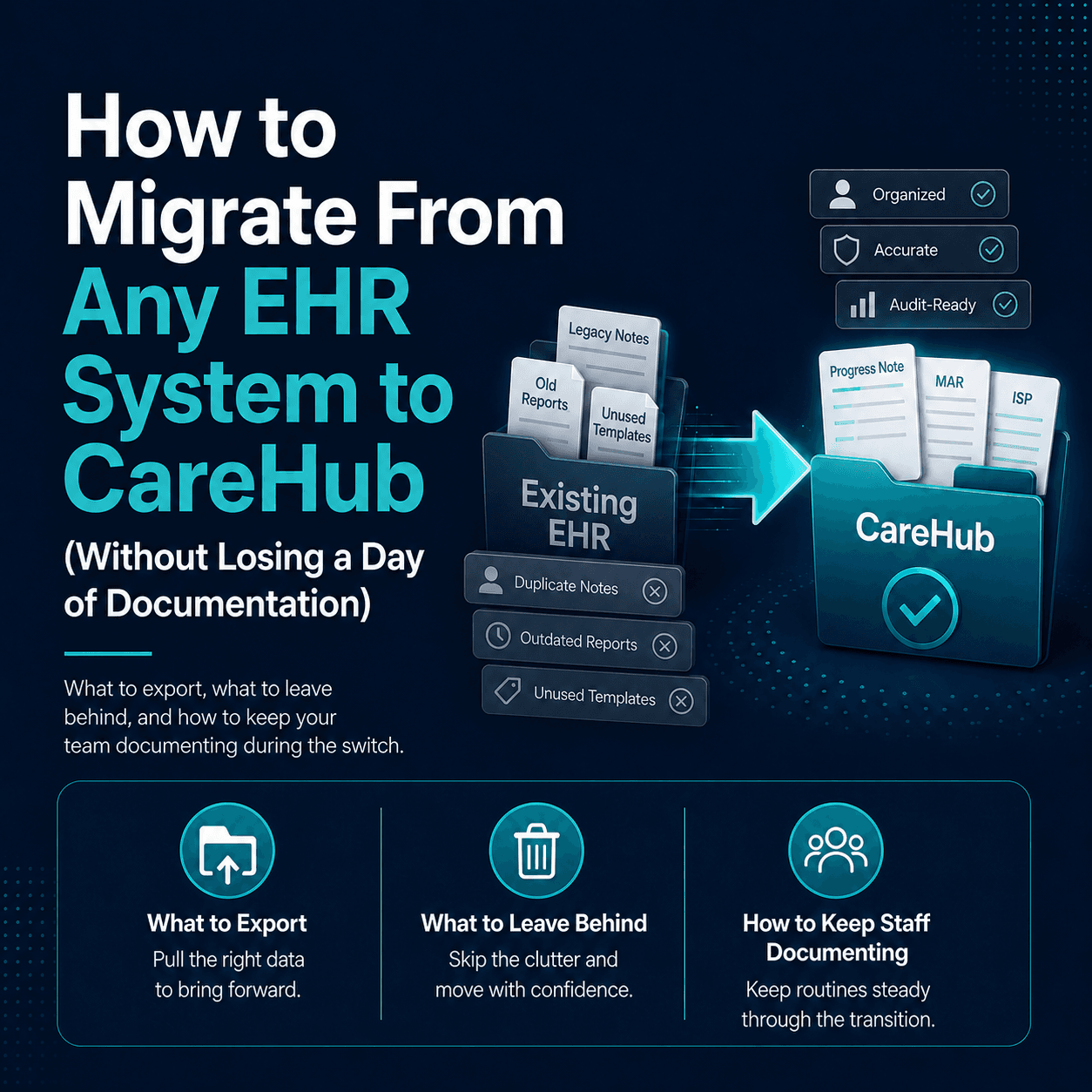
The hardest part of switching EHRs isn't the new software. It's the four weeks during which both systems are open, your team is half-trained, and a surveyor could walk in any morning. We've helped enough providers move off legacy EHRs into CareHub — Therap, Lauris, Credible, Sandata, AccuMed, paper binders, and more — to know the playbook that works and the one that doesn't.
Here's the playbook that works, regardless of what you're coming from.
Before you migrate: the three decisions that save you a month
- Pick the cutover date and freeze it. Most teams want a "trial period" with both systems running. Resist this. Pick a date 14 days out, mark it on every program calendar, and commit. Two systems running in parallel for more than 14 days creates dual-entry burnout and inconsistent records.
- Decide what you're carrying over and what you're archiving. You don't need every individual's daily note from 2018 inside CareHub. You need the active ISP, current medication list, recent (90-day) incident history, demographic and insurance data, and any open compliance items. Archive the rest as PDF exports filed by individual.
- Pick one person as the migration lead. Not the executive director. Not the IT contractor. A QIDP or program manager who already knows your individuals and your forms. They become the single point of contact for your CareHub onboarder.
What to export from your current EHR
Whether you're on Therap, Lauris, Credible, Sandata, AccuMed, or something else, export these in this order:
- Individual face sheets (demographics, contacts, insurance)
- Active ISPs / PCPs / PDPs with current goals and outcomes
- Current medication lists (MAR setup data)
- Last 90 days of daily notes per individual
- Open incident reports
- Staff list with credentials, training records, and certifications
- Service authorizations and plan dates
Most legacy EHRs export to CSV, Excel, and PDF bundles. Don't try to convert them yourself. Send the export bundle to your CareHub onboarder; we map the data into the right CareHub fields and load it for you.
If your current system doesn't support bulk export (some older systems don't), tell us upfront — we have workarounds for that, including reading PDFs and OCR'ing scanned binders.
What CareHub's free migration concierge actually does
When you start a CareHub trial, our migration team will:
- Load every individual face sheet into CareHub (no re-entry)
- Bring over your active ISPs / PCPs / PDPs and goals
- Initialize the MAR with your current med list
- Re-create your forms (incident report, daily note template, monthly progress) so they look like what your team is used to
- Train your team in two 60-minute sessions
- Stay on call for the first 30 days
This is included in any paid plan. There is no migration fee. There is no per-record charge.
The cutover-day checklist
- All staff have CareHub logins (sent the day before)
- Each program location is set up with rooms, individuals assigned, and shifts visible
- The current MAR is loaded for every individual receiving meds
- One QIDP is at each program for the first shift to coach on the new daily-note flow
- The old system is set to read-only at end of business on cutover day
- A "questions go here" Slack channel or group text is open for the first 7 days
The most common migration mistakes
- Trying to migrate during your annual licensing window. Pick a slack month.
- Bringing over years of historical notes. You don't need them. PDF-archive them by individual and move on.
- Skipping the team training because "the old system was harder." A 60-minute training is the difference between an adoption rate of 95% and one of 50%.
- Letting the old system stay editable for "just one more week." It always becomes another month. Lock it down on cutover day.
- Underestimating the data clean-up. Your old EHR almost certainly has stale individuals, expired meds still listed, and discontinued programs. Migration is a perfect moment to clean that up — but it adds time, so plan for it.
Coming from Therap
Therap's bulk exports come out as CSVs and PDFs. The most common gotcha: Therap's "active ISP" record sometimes lives in two different modules (the ISP and the supports plan). Send us both — we'll reconcile them in CareHub.
Coming from Lauris / Credible / Sandata
These systems often have richer billing data and lighter clinical documentation. Send us the billing extracts alongside the clinical exports — we use them to verify service authorizations match what's been billed, which sometimes surfaces revenue you didn't know you were owed.
Coming from paper or a custom Access database
This is more common than people admit. We've migrated providers from three-ring binders, SharePoint folders, and Microsoft Access databases. Bring whatever you have, in whatever format. Our team OCRs PDFs and parses spreadsheets. The work is real but it's been done many times before.
Where CareHub fits
CareHub was built by a residential provider who got tired of paying legacy-EHR pricing for software that didn't fit DBHDS-licensed DD work. Our daily-note form pulls ISP goals automatically. Our MAR enforces witness signatures on controlled meds. Our incident module triggers an RCA when severity warrants it. And our pricing is published — no quote required.
If you're paying for an EHR that doesn't fit and you're thinking about moving, start a free 14-day trial and we'll get on a call within one business day to plan your migration.
Share this article
Help another DD-waiver provider find this.
One short, useful email per week
State regulatory bulletins, customer wins from real DD-waiver providers, a free resource in each issue. One-click unsubscribe.
Keep Reading
More from the CareHub blog
Article
The MAR Errors That Fail a DBHDS Medication Audit (and How to Prevent Them)
The Medication Administration Record is the second thing a DBHDS surveyor pulls after daily notes. Here are the MAR mistakes that draw citations — blank boxes, PRN follow-ups, controlled-count gaps, undocumented refusals — and how to close them before your annual review.
Read articleArticle
Choosing an IDD EHR: The Buyer's Checklist
Most IDD EHR demos look the same for the first twenty minutes. Here is the checklist that surfaces the differences that actually matter — pricing model, what's included, compliance depth, migration, and audit-readiness.
Read articleArticle
ISP Part V (Plan for Supports), Section by Section
The Part V / Plan for Supports is the operational heart of the ISP — the part staff actually document against. Here is what belongs in each section, and what a reviewer checks when they read it.
Read article