
Article
MAR Best Practices for DD Residential Providers
Medication administration records are one of the most-cited areas in DD licensing. Here's how to set up a MAR that's defensible, easy for DSPs, and clean under audit.

CareHub by DSPlife
·3 min read
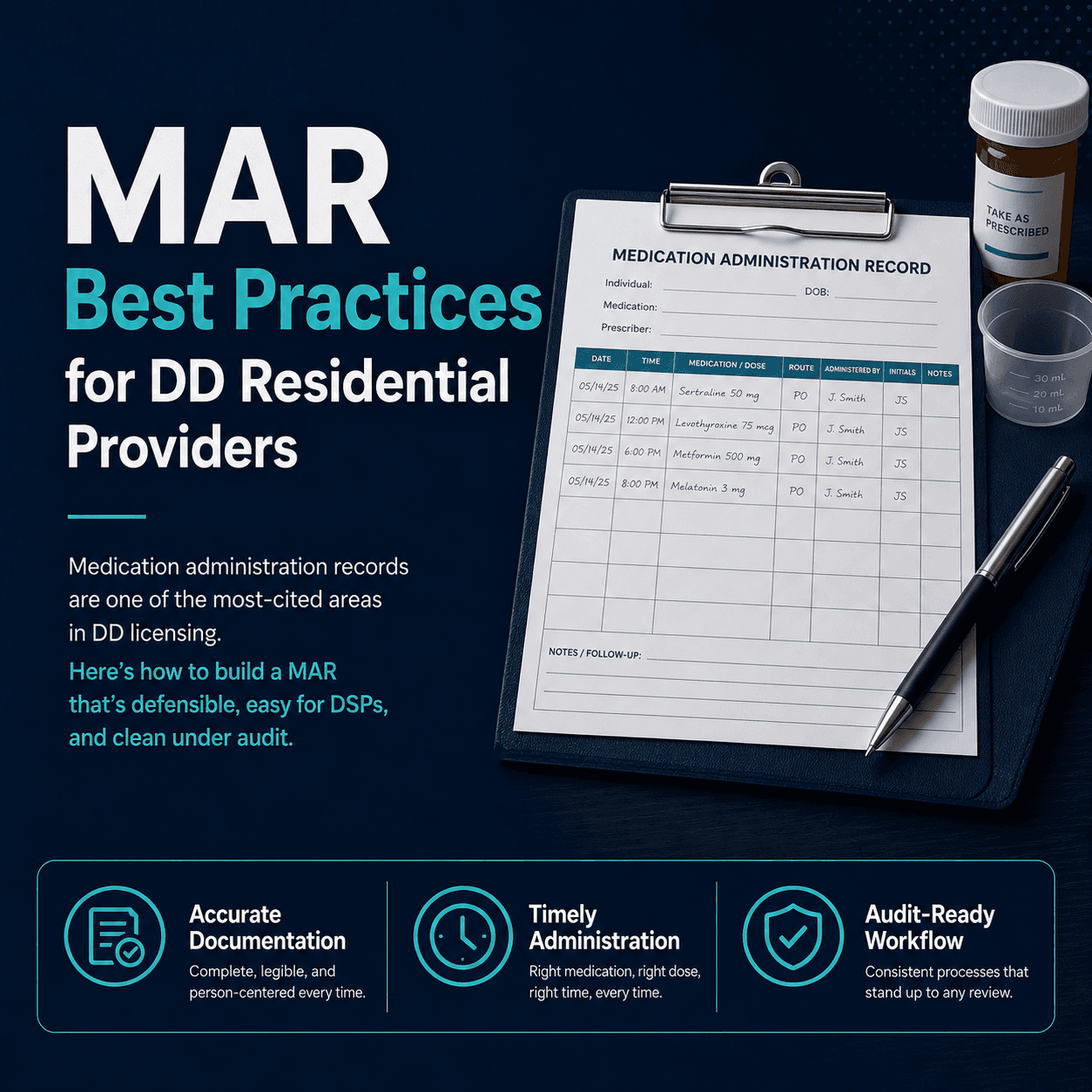
If you run a residential DD program, the MAR is the single most-audited document you produce. Surveyors will pick a random week, walk into a med cabinet, and reconcile what's in the bottle against what's on the MAR. If those numbers don't match, you have a citation.
Here is how to set up a MAR that holds up.
The five MAR rules every program needs
- Initial at the time of administration, not at the end of the shift. End-of-shift initialing is the single most common reason MARs and pill counts don't reconcile.
- Document refusals, holds, and PRN administrations the same way as scheduled doses. A blank slot is a citation. A "refused — see notes" with a note explaining the refusal is documentation.
- PRN protocols must be on the MAR. If a PRN says "for anxiety," the MAR must include the threshold (when to give), the max dose in 24 hours, and the action if no relief.
- Witness signatures on controlled substances. Two staff present, both initial, both count.
- Pharmacy reconciliation monthly. Compare every active med against the latest pharmacy order. New scripts get added; discontinued meds get crossed off with a date and a reason.
The most-cited MAR findings
In our review of recent DBHDS and DODD MAR citations, the consistent patterns:
- Blank slots with no refusal documented. A surveyor sees a blank slot, asks the DSP, and gets "Oh, she refused that day." If it's not on the MAR, it didn't happen.
- PRN given without a threshold met. PRN psych meds especially — surveyors will ask "what was the threshold for giving this PRN?" and expect a documented answer.
- MAR initials that don't match staff schedule. DSP initialed for the 10 AM dose but wasn't on shift until noon.
- Med cabinet count off by one. Even a single pill discrepancy on a controlled substance is a citation.
- Discontinued med still on the MAR. Not crossed off, no date.
How to train DSPs on MAR
A 30-minute monthly refresher is more effective than an annual training. Every month, pull two real MAR errors from your own records (anonymized), present them to the team, and walk through what should have happened. This builds pattern recognition.
Also: have every new DSP shadow a med pass with a senior staff person before they ever sign a MAR alone. Three shadow passes minimum.
Pharmacy partnership matters
The strongest residential programs have a relationship with one pharmacy and use the pharmacy's monthly med report as the source of truth for reconciliation. If your individuals are getting meds from three different pharmacies, reconciliation becomes a chore and discrepancies multiply.
Where CareHub fits
CareHub's MAR module enforces the rules above:
- Required reason field on any blank or refused dose
- PRN administration requires the threshold to be selected (auto-populated from the protocol)
- Controlled-substance doses require a second-staff witness
- Monthly pharmacy reconciliation worklist auto-generated from pharmacy upload
- Every initial is timestamped with the staff person and time of action — no end-of-shift retro-initialing
It's the difference between a MAR you can hand to a surveyor without sweating and one you have to pre-clean before every visit.
Start a free 14-day trial and we'll set up your MAR with your active med list on day one.
Share this article
Help another DD-waiver provider find this.
One short, useful email per week
State regulatory bulletins, customer wins from real DD-waiver providers, a free resource in each issue. One-click unsubscribe.
Keep Reading
More from the CareHub blog
Article
The MAR Errors That Fail a DBHDS Medication Audit (and How to Prevent Them)
The Medication Administration Record is the second thing a DBHDS surveyor pulls after daily notes. Here are the MAR mistakes that draw citations — blank boxes, PRN follow-ups, controlled-count gaps, undocumented refusals — and how to close them before your annual review.
Read articleArticle
Choosing an IDD EHR: The Buyer's Checklist
Most IDD EHR demos look the same for the first twenty minutes. Here is the checklist that surfaces the differences that actually matter — pricing model, what's included, compliance depth, migration, and audit-readiness.
Read articleArticle
ISP Part V (Plan for Supports), Section by Section
The Part V / Plan for Supports is the operational heart of the ISP — the part staff actually document against. Here is what belongs in each section, and what a reviewer checks when they read it.
Read article