Article
Individual Options Waiver Documentation Checklist (Ohio)
What Ohio Individual Options (IO) Waiver providers must document, how DODD reviews work, and what county boards look for during compliance reviews.

CareHub by DSPlife
·3 min read
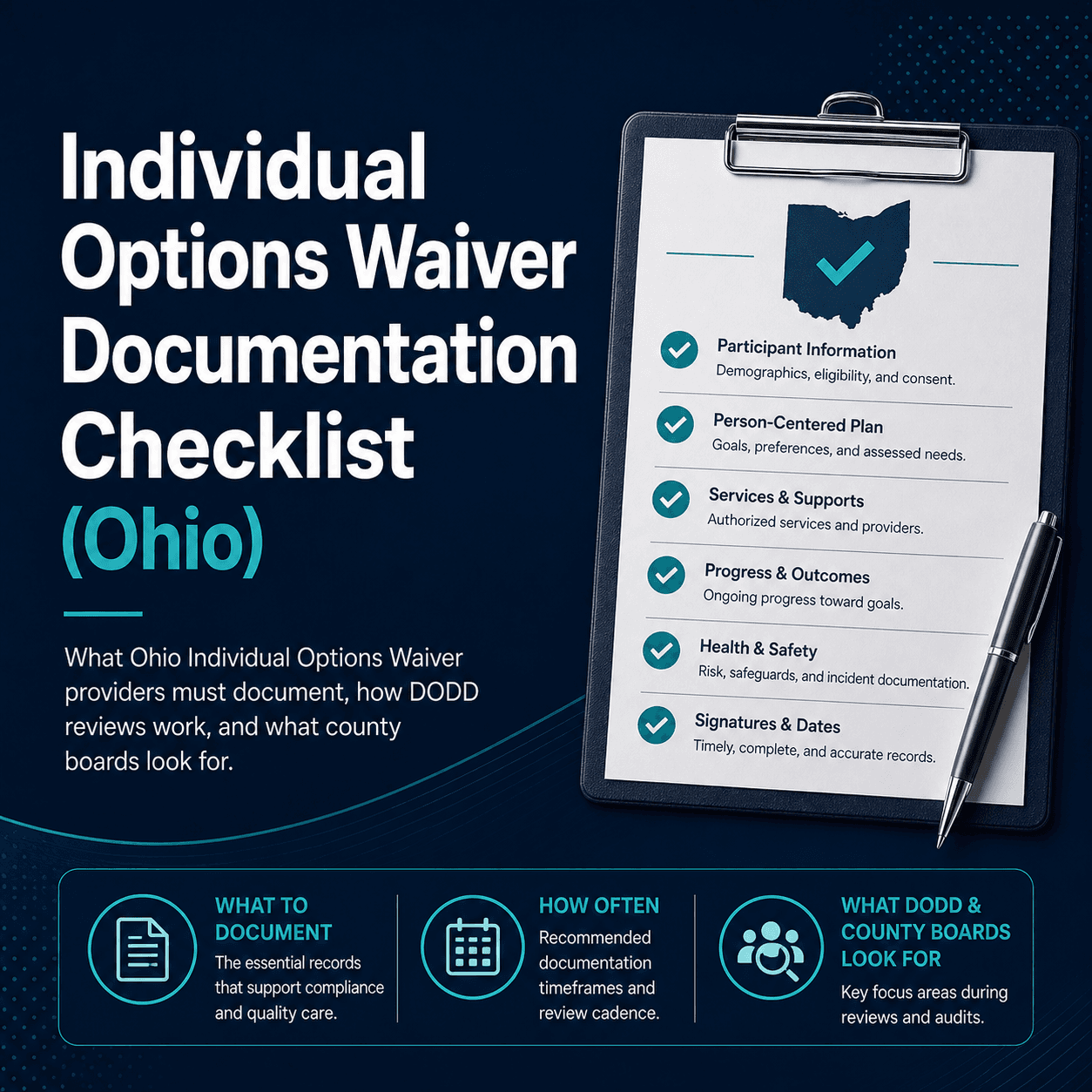
The Individual Options (IO) Waiver is Ohio's largest DD waiver and the one most residential and HPC providers operate under. DODD oversight is layered with county-board oversight, which means your documentation has to satisfy two audiences. Here is the documentation that does.
The IO documentation pillars
- Individual Service Plan (ISP) — annual, reviewed at least once per year by the SSA
- Service documentation — every shift, every billable service, tied to ISP outcomes
- Major Unusual Incident (MUI) reports — per DODD definitions and timelines
- Unusual Incident (UI) reports — internal documentation, county-board-reportable
- Health and welfare alerts — DODD's electronic system for serious health issues
- Background checks and training records — staff-side documentation that gets pulled in every audit
The ISP
Ohio's ISP is built by the SSA (Service and Support Administrator), but providers must document services against the ISP outcomes. A defensible ISP includes the individual's vision, identified outcomes, supports authorized to address each outcome, the team that participated, signatures, and an effective date. As a provider, you don't write the ISP — but you must document services that align with it.
Service documentation requirements
For each billable IO service (Adult Day Support, Vocational Habilitation, HPC residential, etc.), daily documentation must include:
- Date of service
- Service name and code
- Time in / time out
- Specific support the staff member provided
- Individual's response
- Staff signature
Documentation must be entered within the timeframe in your provider agreement (typically same-day or next-business-day). Ohio Medicaid audits will pull random days and ask for the documentation that supports the billed service — if the time in/out doesn't match, the claim is recouped.
MUIs vs UIs
DODD's definitions matter:
- MUI — death, abuse, neglect, exploitation, attempted suicide, missing person, peer-to-peer act, prohibited sexual relations, rights code violation, unapproved behavior support, misappropriation, significant injury — reportable to DODD within 4 hours via the MUI/UI online system
- UI — minor injury, property damage, peer-to-peer that doesn't rise to MUI threshold, behavioral incident — internal documentation required, county-board notification per their policy
The most common DODD finding: an event is documented as a UI when it should have been an MUI. When in doubt, treat it as MUI and let DODD downgrade.
Health and welfare alerts
If an individual experiences a hospitalization, significant medication change, or new health diagnosis, you must enter a Health and Welfare Alert in DODD's system. Late entries are a citation; missing entries are a potential corrective action.
Staff documentation
Ohio audits always pull staff records: BCI/FBI background checks (initial + 5-year repeat), DODD training certifications, MUI/UI training, abuse-and-neglect-prevention training, current CPR/first-aid. Missing or expired records on a single staff person can trigger a corrective action even if every individual's documentation is perfect.
What auditors actually look for
- Service notes whose times don't match the billed claim
- MUIs miscategorized as UIs
- Health and Welfare Alerts entered late or not at all
- Staff records missing required certifications
- ISP service authorizations that don't match the services billed
Where CareHub fits
CareHub's Ohio IO setup includes service forms with billable-time calculation, MUI/UI severity routing that flags MUI-level events for DODD reporting, a Health and Welfare Alert generator, and staff-credentialing tracking with auto-expiration alerts.
Start a free 14-day trial — or download our Ohio IO documentation checklist as a printable PDF.
Share this article
Help another DD-waiver provider find this.
One short, useful email per week
State regulatory bulletins, customer wins from real DD-waiver providers, a free resource in each issue. One-click unsubscribe.
Keep Reading
More from the CareHub blog
Article
The MAR Errors That Fail a DBHDS Medication Audit (and How to Prevent Them)
The Medication Administration Record is the second thing a DBHDS surveyor pulls after daily notes. Here are the MAR mistakes that draw citations — blank boxes, PRN follow-ups, controlled-count gaps, undocumented refusals — and how to close them before your annual review.
Read articleArticle
Choosing an IDD EHR: The Buyer's Checklist
Most IDD EHR demos look the same for the first twenty minutes. Here is the checklist that surfaces the differences that actually matter — pricing model, what's included, compliance depth, migration, and audit-readiness.
Read articleArticle
ISP Part V (Plan for Supports), Section by Section
The Part V / Plan for Supports is the operational heart of the ISP — the part staff actually document against. Here is what belongs in each section, and what a reviewer checks when they read it.
Read article