
Article
DBHDS RCA Form: Complete Guide + Template
Root Cause Analysis is one of the highest-stakes DBHDS deliverables. This guide walks you through what's required, what surveyors actually look for, and a template you can use today.

CareHub by DSPlife
·3 min read
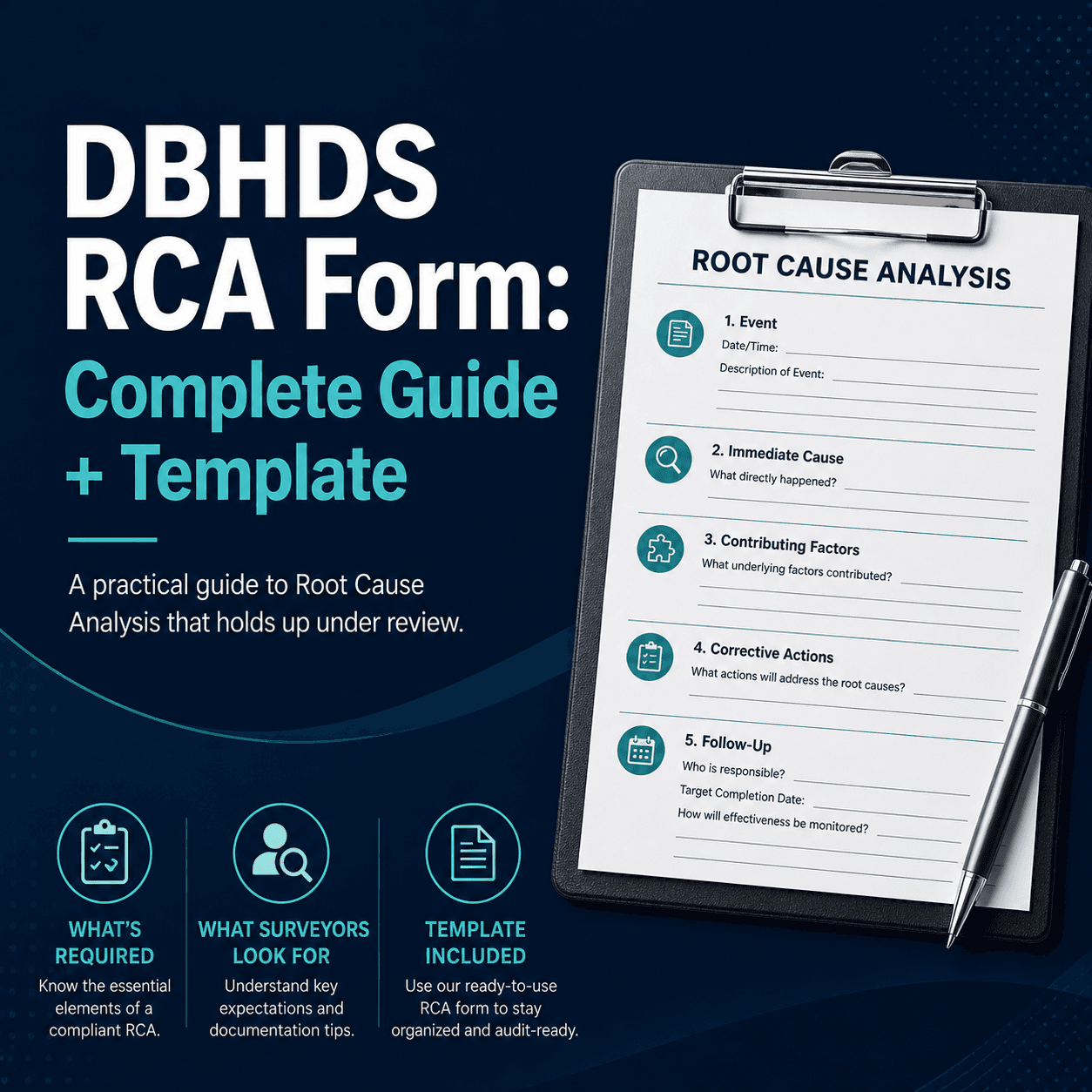
A Root Cause Analysis (RCA) is what DBHDS expects when something goes wrong that shouldn't have. It's not optional. It's not informal. And the difference between an RCA that passes review and one that doesn't is usually less about the incident itself and more about how clearly the form connects the dots from event to corrective action.
Here is the structure DBHDS expects, the questions surveyors actually ask, and a template you can adapt for your provider.
When you owe DBHDS an RCA
You're required to perform an RCA when a serious incident meets one of the following: a Level III incident, a death, a series of related Level II incidents, an investigation finding of abuse or neglect that was substantiated, or a pattern surfaced by your CQI committee. If you're unsure, err on the side of completing one — having an extra RCA on file is never a finding; missing one is.
The seven sections of a passable RCA
- Incident summary. Who, what, when, where. One paragraph. Stick to facts; do not editorialize.
- Immediate response. What did staff do in the first 60 minutes? Document times. Surveyors will compare this against your house log.
- Timeline of contributing factors. Walk backward from the incident. Each factor gets a line: "Prior to incident: staff:individual ratio dropped from 1:2 to 1:4 between 4 and 6 PM due to call-out."
- Root cause(s) identified. This is the section most providers fumble. The root cause is not "staff didn't follow procedure." Ask "why" five times until you reach a system condition: "Procedure not followed → procedure unclear → revised procedure was emailed but not reviewed in shift huddle → no mechanism to confirm staff have read policy revisions."
- Corrective actions. For each root cause, name a specific change with an owner and a deadline. "By 6/15: shift-huddle agenda will require sign-off on any policy revision in the prior 30 days. Owner: program manager."
- Verification plan. How will you know the corrective action worked? "QA audit of 10 random shift-huddle logs in August will confirm sign-off field is being completed."
- CQI committee review and signature. RCA goes to your CQI committee. Their signature on the form is what closes the loop.
What surveyors actually look for
A surveyor reading your RCA is asking three questions:
- Did you take it seriously? A two-paragraph RCA on a Level III incident reads as careless. A six-page RCA on a missed PRN reads as defensive. Match the depth to the severity.
- Did you fix the system, or did you fire someone? "Counseled staff" is not a corrective action. Counseling can be a part of the response, but the RCA needs a system change.
- Will you know if it happens again? Your verification plan is the proof. A vague "we will monitor closely" gets cited every time.
The most common RCA citations
- No timeline. Just a narrative paragraph. Surveyors want to see the chronology mapped out.
- Root cause = staff fault. "Staff did not follow procedure" stops one layer too early.
- No deadlines on corrective actions. "Will revise policy" is not a corrective action.
- CQI committee never reviewed it. The committee log doesn't show the RCA being presented.
- No follow-through. Surveyor pulls the RCA from six months ago and asks for the verification audit. You don't have one.
A template you can use today
Open a document with the seven section headers above. Fill each one with the prompts in this guide. When you're done, ask one person who wasn't in the room when the incident happened to read the RCA and tell you what they think the root cause was. If their answer matches what you wrote, you're ready for the CQI committee. If it doesn't, your "why" chain stopped one layer too early.
Where CareHub fits
CareHub's incident module flags any incident whose severity triggers an RCA, opens the RCA form pre-populated with the incident timeline, and routes it to your CQI committee for sign-off. It also schedules the verification audit on the date you set in the corrective action — so when DBHDS asks "how do you know it worked," the answer is in the same record.
If you're tracking RCAs in a folder of Word docs right now, the next licensing visit is going to find the gap. Try CareHub free for 14 days — or download our free RCA template and start with that.
Share this article
Help another DD-waiver provider find this.
One short, useful email per week
State regulatory bulletins, customer wins from real DD-waiver providers, a free resource in each issue. One-click unsubscribe.
Keep Reading
More from the CareHub blog
Article
The MAR Errors That Fail a DBHDS Medication Audit (and How to Prevent Them)
The Medication Administration Record is the second thing a DBHDS surveyor pulls after daily notes. Here are the MAR mistakes that draw citations — blank boxes, PRN follow-ups, controlled-count gaps, undocumented refusals — and how to close them before your annual review.
Read articleArticle
Choosing an IDD EHR: The Buyer's Checklist
Most IDD EHR demos look the same for the first twenty minutes. Here is the checklist that surfaces the differences that actually matter — pricing model, what's included, compliance depth, migration, and audit-readiness.
Read articleArticle
ISP Part V (Plan for Supports), Section by Section
The Part V / Plan for Supports is the operational heart of the ISP — the part staff actually document against. Here is what belongs in each section, and what a reviewer checks when they read it.
Read article