
Article
How to Write a DBHDS-Compliant Daily Note (With Examples)
A step-by-step guide for DSPs and QIDPs on writing daily progress notes that hold up under DBHDS licensing reviews. Includes good and bad examples, the mandatory data points, and the most common audit findings to avoid.

CareHub by DSPlife
·3 min read
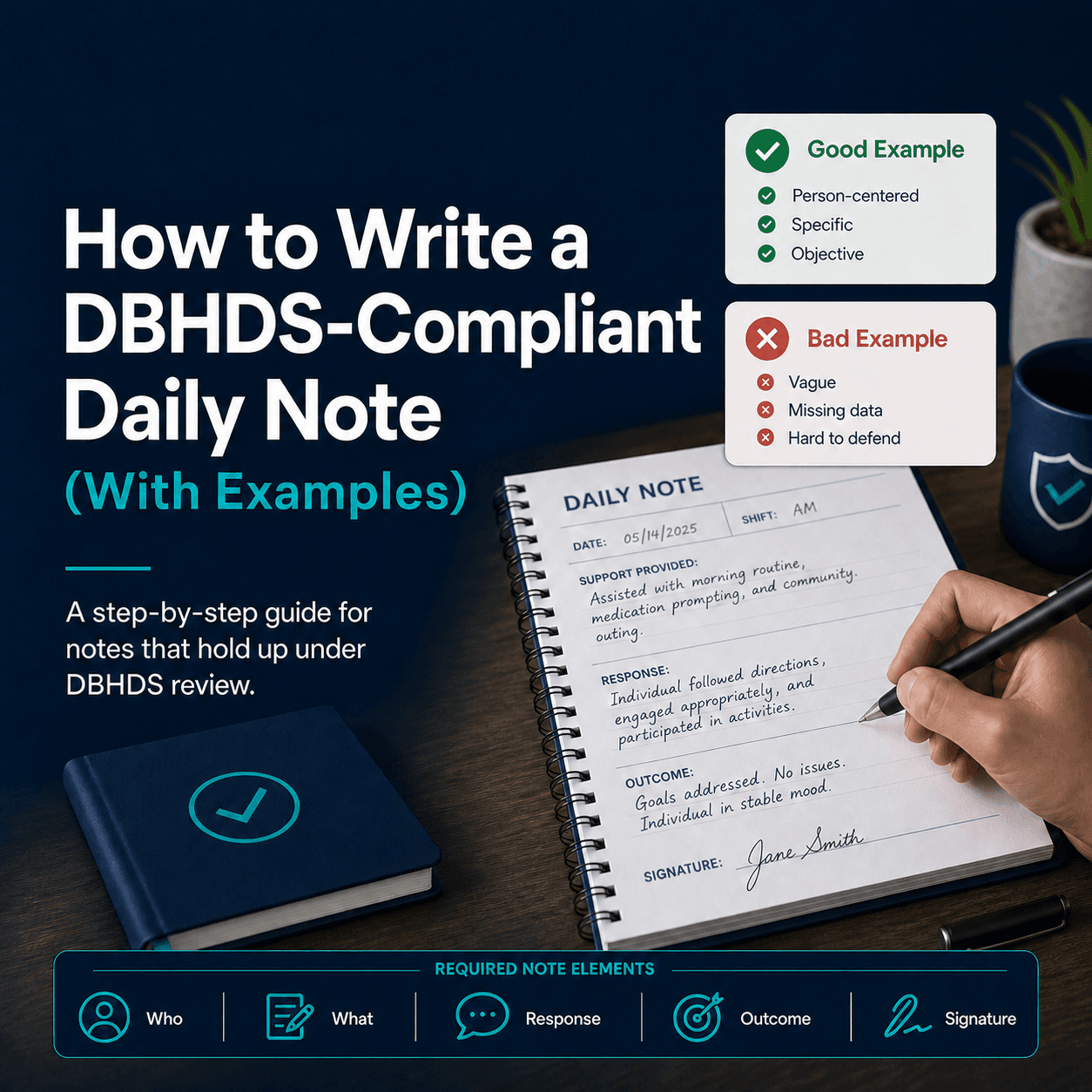
If your daily notes can't survive a DBHDS Licensing Specialist's read-through, the rest of your documentation doesn't matter. Notes are the first thing surveyors pull, the easiest thing to write poorly, and the single biggest source of citations on annual reviews.
Here is what a defensible daily note looks like, what makes one fail, and how to train your team to write the right kind every shift.
The five things every DBHDS daily note must include
A defensible note ties back to the individual's plan and shows what staff actually did. At a minimum:
- Date, shift, and staff signature. Late entries are allowed; backdated entries are not. If you write the note three days later, write the note's actual date and reference the date of the shift it covers.
- Services delivered against the plan. The note must reference the goal, outcome, or support strategy from the current ISP. "Worked on community engagement goal: practiced ordering at the counter at the local diner" is reviewable. "Had a good day" is not.
- Individual's response. What did the person do, refuse, request, or improve at? Surveyors look for evidence the individual is the subject of the service, not the object of it.
- Health and safety observations. Any incident, behavior of concern, missed medication, fall, refusal, mood change, or skin observation belongs in the note (and may belong in a separate incident report).
- Plans for follow-up. If the individual asked to call their mother and the call didn't happen, what happens tomorrow?
A good note vs. a bad note
Bad: "M had a good shift. We watched a movie and he ate dinner."
This note has no plan reference, no measurable outcome, no health observation, and no follow-up. A surveyor reading 30 of these in a row will write a citation that says staff aren't delivering the services billed for.
Good: "3-11 shift. Worked on M's community-engagement goal (ISP outcome 2.1). Walked to the corner store, M selected three grocery items independently and counted out cash with verbal prompting only. Took meds at 5:00 and 9:00 with no concerns. M reported 4/10 anxiety after a phone call with his sister; offered preferred coping strategy (music + headphones) which he accepted. Plan: continue daily store practice; flag mood for QIDP review at next monthly. — A. Chen, DSP"
This note is reviewable, billable, and shows progress.
The most common DBHDS daily-note citations
In our review of recent licensing reports, the four findings that show up over and over:
- No reference to the ISP. Notes describe activities but never connect them to the plan.
- Templated language. "Individual was assisted with ADLs" appears verbatim across 30 days. Surveyors flag this as cut-and-paste documentation.
- No mention of skipped or refused services. A clean note that misses every refused medication or skipped activity is worse than one that documents the refusal honestly.
- Late notes with no explanation. A 7-day-late note isn't a violation — but it must say why it's late and who entered it.
Train your team in three steps
- Hand every DSP a one-page "anatomy of a good note" reference. Keep it laminated in every program.
- Read 10 random notes per individual every week. Send a brief, kind note back to staff who hit all five elements. Coach the ones who don't.
- Pull the previous week's notes the day before any monthly QIDP review. Bad notes caught at the monthly are cheap; bad notes caught at the licensing visit cost your renewal.
Where CareHub fits
CareHub's daily-note form pulls the individual's active goals into the note, requires a goal-linked progress field, and time-stamps the entry. Late entries are allowed but flagged with the original shift date and a required reason. We built it after sitting through enough DBHDS exit interviews to recognize the pattern — and we built it to make the bad note harder to write than the good one.
If your team is still writing notes in a Google Doc or a paper binder, the easiest 30 minutes you'll spend this week is reading 10 of last month's notes and grading them against this checklist. The second easiest is trying CareHub free for 14 days.
Share this article
Help another DD-waiver provider find this.
One short, useful email per week
State regulatory bulletins, customer wins from real DD-waiver providers, a free resource in each issue. One-click unsubscribe.
Keep Reading
More from the CareHub blog
Article
The MAR Errors That Fail a DBHDS Medication Audit (and How to Prevent Them)
The Medication Administration Record is the second thing a DBHDS surveyor pulls after daily notes. Here are the MAR mistakes that draw citations — blank boxes, PRN follow-ups, controlled-count gaps, undocumented refusals — and how to close them before your annual review.
Read articleArticle
Choosing an IDD EHR: The Buyer's Checklist
Most IDD EHR demos look the same for the first twenty minutes. Here is the checklist that surfaces the differences that actually matter — pricing model, what's included, compliance depth, migration, and audit-readiness.
Read articleArticle
ISP Part V (Plan for Supports), Section by Section
The Part V / Plan for Supports is the operational heart of the ISP — the part staff actually document against. Here is what belongs in each section, and what a reviewer checks when they read it.
Read article