Article
6 Reasons CareHub Is What Therap Is Announcing — Already Shipping
Therap recently announced an AI strategy at their national conference. CareHub already ships the equivalent capabilities, built specifically for DD-waiver providers. A side-by-side, verifiable feature by feature.

CareHub by DSPlife
·3 min read
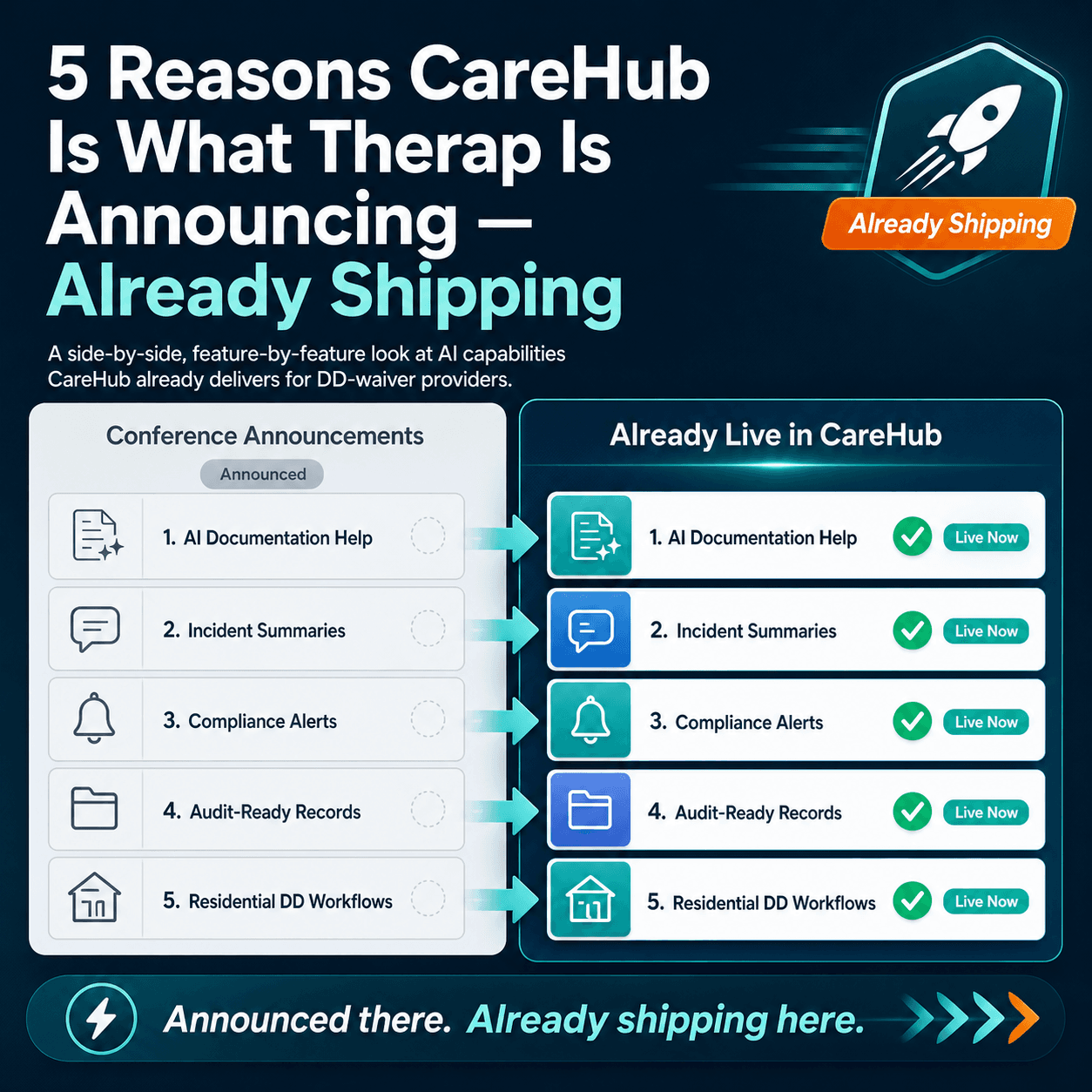
At a recent Therap National Conference, back-to-back keynotes covered what they're calling their new AI strategy: a QA Assistant that scans documentation, an AI Summarization tool, automated facial-recognition attendance. Big stage, big slides, big room.
We watched the announcements with appreciation — and went back to work on CareHub, which already ships the equivalent capabilities for DD-waiver providers.
If you're a DD-waiver provider weighing your options, here's the honest, verifiable side-by-side. Six things Therap announced — and what CareHub already does.
1. AI documentation assistance: Smart Draft + Smart Rephrase
Therap announced AI Summarization to "automatically generate concise, report-ready summaries" from documentation.
CareHub ships two AI tools on every daily note, on every account:
- Smart Draft — one click on the daily-note form generates a person-centered scaffold from the individual's active PCP outcomes, life areas, and support instructions. The DSP edits to add real observations. Built explicitly to give staff a starting point instead of a blank box.
- Smart Rephrase — rewrites a DSP's draft into professional, DBHDS-compliant English. Auto-detects Spanish input and translates it to English first, so Spanish-speaking DSPs can document in their first language and get clean compliant text out. The same engine can also translate finished English notes into formal Spanish for sharing with Spanish-speaking families and SDMs.
Both features are HIPAA-compliant, run through Anthropic Claude with no third-party retention, and are tracked in CareHub's AI Usage panel so you can see the math on every dollar spent. No separate AI module, no extra subscription.
2. Documentation safety net: Compliance Dashboard + injury auto-detect
Therap announced their QA Assistant: AI that "spots potential issues that require a closer look, such as a daily note that includes injury details better suited for an incident report."
CareHub does this two ways:
- Compliance Dashboard at
/dsp/reports/compliance-dashboard— tabs for forms summary, missing submissions, PCP compliance, notes coverage, and face-sheet completeness. QIDPs and license admins see drift in real time, not on a quarterly report. - Injury keyword auto-detect on the daily-note form — when a DSP types injury keywords in the comments box (fall, bruise, blood, ER, hospital, fracture, seizure, choking, elopement, med error, and ~25 others), an inline amber prompt appears: "Possible incident detected — flag for IR?" One click flips the IR-required toggle and scrolls the DSP to the IR section. The check runs every keystroke. No AI required for this one — it's a deterministic keyword scan, which is faster, cheaper, and never silently misses.
We don't wait for an LLM to finish thinking before the safety net catches a missed incident report.
3. Audit-readiness: One-click DBHDS Audit Packet PDF
Therap doesn't have a one-click audit packet. Their suggested audit-prep workflow involves running multiple reports and manually assembling the file.
CareHub ships the DBHDS Audit Packet PDF at /dsp/reports/insights — pick a date range and the individuals to include (up to 10 per packet), get back a single PDF with a cover page, table of contents, and one section per individual: face sheet, ISP summary, MAR summary (active meds, administrations, refusals, missed in window), incidents in the date range, and the most recent daily notes. Designed to hand to a DBHDS Licensing Specialist on day one of the survey window. Available on Professional plans and above.
4. Family + guardian access: Magic-link signing, no account required
Therap historically requires guardians and SDMs to create their own accounts to view documentation or sign forms. Most don't.
CareHub ships magic-link e-signing for custom forms, admission packets, and the Guardian Family Portal: guardians, SDMs, and case managers all get one-click access via an email link. No account creation, no password reset chain. The signature is captured with full identity-verification audit trail using a verification-code email — DBHDS-compliant and easier than the alternative.
5. Pricing transparency + free migration
Therap publishes no pricing. Migrations are scoped, quoted, and contracted.
CareHub publishes every plan, every add-on, every dollar at carehub.mydsplife.com/pricing. Plans run $149-$699/month (or save 5% billed annually), no contract, monthly billing. Migration is free — our team pulls your data from Therap, Lauris, Credible, or anything else and loads it into CareHub at no charge. Custom Enterprise subscriptions are available for larger organizations — contact us for a quote.
The reason we can do that and Therap can't: every CareHub migration is a paying customer for the recurring fee. Their pricing model is locked into 5-figure annual contracts; ours is built for monthly retention.
6. Built for one segment, not many
Therap serves human services broadly: I/DD residential, behavioral health, ABA providers, foster care, state-agency contracts, supported employment, day programs, ICF/IID, and HCBS more generally. Hundreds of DD-waiver provider organizations use Therap — that's their largest segment. But the platform is configured to serve everyone, which means most features are designed for the lowest common denominator across all those segments. Then each org configures the platform for its own model.
CareHub is built for DD-waiver providers — operating under DBHDS (Virginia), DODD (Ohio), HHSC (Texas), DHHS (North Carolina), DDA (Maryland), BMS (West Virginia), DBHDD (Georgia), ODP (Pennsylvania), DDS (California), and the comparable state agencies. CareHub supports the full range of waiver service types: residential and sponsored residential, day support (center- and non-center-based), in-home services, community supports and engagement, supported employment, crisis stabilization, case management, ACT, and more — every service category licensed under DBHDS-style regulations. As the waiver service taxonomy expands and as we add deeper support for adjacent service lines, CareHub grows with it. Every form, every report, every workflow is shaped by what DD-waiver providers actually do every day.
Concrete examples of what segment-specific focus produces:
- Forms library: ~30 DBHDS-required forms (RCA, Med Disposal, Admission, Discharge, Annual Acknowledgements, Fire Drill Log, Quarterly ISP Review, etc.) ship out of the box, pre-mapped to DBHDS field requirements. Therap supports forms but you configure each one per-org.
- Daily-note flow: CareHub's daily note pulls in the individual's PCP outcomes, life areas, risks, and routines automatically. Therap's daily-note is more general — works for behavioral health, ABA, IDD all via different field configurations.
- State terminology baked in: CareHub's incident reporting knows DBHDS severity levels, Ohio's MUI/UI definitions and 4-hour reporting window, and NC's IRIS portal requirements. Therap supports all states but treats them uniformly until you configure otherwise.
- Audit packet: A CareHub audit packet is a DBHDS-style packet by default. If you've ever sat through a Licensing Specialist's exit interview, you know the difference between "configurable PDF" and "this is what a DBHDS surveyor expects."
The trade-off is real. Therap may have an integration CareHub doesn't (because they have a state-agency contract or a behavioral-health partner). CareHub may have a workflow Therap doesn't (because we ship a DBHDS-form template you don't have to build yourself). Pick the platform shaped like the work you actually do.
The pattern
CareHub treats AI and modern UX as table stakes, not as a future announcement. That's not a miracle — it's the difference between a codebase built for the AI era and an older codebase being retrofitted with AI.
We don't have Therap's customer count. They have ~3,500 organizations on the platform, decades of integrations, and a national conference with 250+ sessions. We respect the company.
What we have is velocity — we ship continuously, sometimes daily — and the focus that comes from building specifically for one buyer: DD-waiver providers operating under DBHDS, DODD, HHSC, DHHS-MH/DD, and the comparable state agencies.
If that's your operation and you're tired of waiting for your EHR to catch up to what you actually need, start a 14-day free trial. Free migration if you're moving off Therap. The team that built CareHub is two waiver providers and a small engineering staff. We will reply to your email.
— Eric & Dana DSPlife Collaborative Group
Share this article
Help another DD-waiver provider find this.
One short, useful email per week
State regulatory bulletins, customer wins from real DD-waiver providers, a free resource in each issue. One-click unsubscribe.
Keep Reading
More from the CareHub blog
Article
The MAR Errors That Fail a DBHDS Medication Audit (and How to Prevent Them)
The Medication Administration Record is the second thing a DBHDS surveyor pulls after daily notes. Here are the MAR mistakes that draw citations — blank boxes, PRN follow-ups, controlled-count gaps, undocumented refusals — and how to close them before your annual review.
Read articleArticle
Choosing an IDD EHR: The Buyer's Checklist
Most IDD EHR demos look the same for the first twenty minutes. Here is the checklist that surfaces the differences that actually matter — pricing model, what's included, compliance depth, migration, and audit-readiness.
Read articleArticle
ISP Part V (Plan for Supports), Section by Section
The Part V / Plan for Supports is the operational heart of the ISP — the part staff actually document against. Here is what belongs in each section, and what a reviewer checks when they read it.
Read article